
The Permanent Underclass Narrative Gets It Backwards
How the Ideaocracy mistakes gatekeeping for capability.

We (the whole industry, not just OpenAI) are building a brain for the world. It will be extremely personalized and easy to use; we will be limited by good ideas. — Sam Altman, “The Gentle Singularity”1
Most people I know in the A.I. industry think the median person is screwed, and they have no idea what to do about it. … While Silicon Valley has long warned about the risk of rogue A.I., it has recently woken up to a more mundane nightmare: one in which many ordinary people lose their economic leverage as their jobs are automated away. — Jasmine Sun, “Silicon Valley is Bracing for a Permanent Underclass”2
Why are you rich, while the other is poor? Isn’t it, if for no other reason, so that you can gain a reward for your kindness and faithful stewardship…? — St. Basil
Recent AI reporting has hit a nerve: the “permanent underclass” speculation is everywhere. But this narrative contains two underlying assumptions worth examining, one old and one relatively new:
The old: Tech-industry-led advances will lead us to the promised land.
The new: Not everyone will be allowed in.
The anxiety feels different this time because it’s spreading beyond the usual suspects. Knowledge workers who have historically benefited from technological advancement are now asking: how will we stay economically relevant? And those positioned to profit most directly from AI development and adoption express concern about mass displacement.
But when we look deeper, we find a false premise: the institutions and networks that position themselves as the vanguard of technological progress3 have presided over the least transformative period in modern technoscientific history.4 This isn’t provocation: it’s a now-boring assertion backed by decades of data and lived experience. Economists have been saying this for twenty years.5 Why the disconnect? Will current AI architectures finally deliver the transformation that has been promised but not manifested for decades?
They might. But if they don’t, I suspect the limiter won’t be the technology—it will be the concentration of power over what gets built with it.
The Ideaocracy
Science is generated by and devoted to free inquiry: the idea that any hypothesis, no matter how strange, deserves to be considered on its merits. The suppression of uncomfortable ideas may be common in religion and politics, but it is not the path to knowledge... We do not know in advance who will discover fundamental new insights. — Carl Sagan, Cosmos6
We’re living in a contradiction. It has never been easier, in theory, for a capable individual to conjure a great idea—tools, information, and capability are at an all-time high.7 Yet the filtering systems that determine which ideas get heard, resourced, and manifested have coalesced and narrowed.
In 1900, fewer people had access to the tools needed to generate good ideas, but the paths to manifestation were more numerous and permeable. Today, access to tools has expanded dramatically, yet capable people with good ideas must pass through filters that have drifted from measuring capability to measuring its proxies. These proxies (where you went to school, where you live, who you know) optimize for legibility and efficiency while embedding assumptions about where capability concentrates and in what types of people. The people running these filters believe they work—because they succeeded under them.
This is how I see the idea-to-realization pipeline and how it has changed over time:
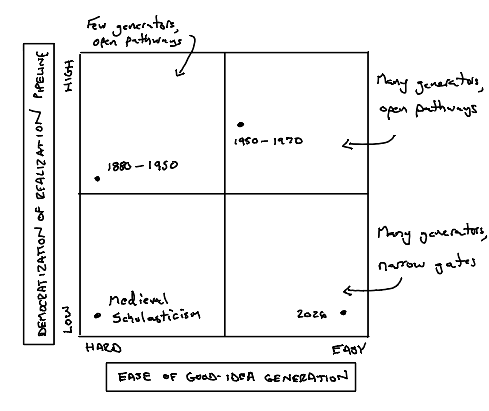
From many conversations on this topic, I’m confident in saying this contradicts a mental model that many people hold: that the world’s best ideas get their shot and succeed based on their merits. This model is foolish to hold with any confidence.
A simple disaggregation of the process entailed in the idea-to-realization pipeline helps illuminate the case. For an idea to matter and manifest, it must pass through four stages: generation, listening, resourcing, adoption. Each stage is a potential chokepoint where good ideas can be lost. Much has been written about failures at the last two stages (e.g., female founding teams receive ~2% of VC funding),8 but the first two are invisible and potentially more limiting. We’re losing ideas at the earliest, least visible stages: suppressed at generation, ignored at listening.
Take the counterfactual: we cannot be absolutely certain we are surfacing the best ideas unless we poll every single person, repeatedly, and subject their ideas to unbiased, perfect evaluation. We’re not doing that. Obviously we can’t. Some system is necessary.
But we should not confuse “a system built over time to satisfy evolving constraints” with “a system currently optimized to find the best ideas.” Even if we began with filters that aimed squarely at answering the question “what selection criteria correlate most strongly with transformative ideas?,” they have been warped by path dependency, convenience, and social reproduction.
Which means we’re highly unlikely to be finding the best ideas. When Sam Altman says AI will make us “limited by good ideas,” he’s part of the system deciding where (and from whom) ideas are allowed to be generated and what gets listened to. If we’re suppressing idea generation in 95% of the population AND filtering out at the door 95% of the ideas that DO get generated... we’re sampling from 0.25% of the potential idea pool. To confidently believe the world’s best ideas exist within that 0.25% sample, you’d have to believe that idea quality is almost perfectly correlated with the ability to pass through our current filters.
If this were the case, the people most capable of good ideas would need to be overwhelmingly concentrated among those who live in the right cities, went to the right schools, and know the right people. Not just somewhat more likely to be found there, but overwhelmingly concentrated. So for “the best ideas rise to the top” to be true, the top would need to be where essentially all the best ideas already are.9
The numbers make the old mental model difficult to maintain: either the current system has somehow discovered near-perfect proxies for ideation capability, or we’re missing many of the best ideas. This isn’t a new pattern. History shows us exactly where this kind of concentration leads.
The New Scholasticism
History shows that the more powerless creative individuals become, the more they are immersed in environments that institutionalize dogmatism. Very few new ideas emerged from the suffocating environment imposed by religious dogma during the Dark Ages... intellectual pioneers need environments that accommodate dissent. — Donald Braben, Scientific Freedom: The Elixir of Civilization10
Consider medieval scholasticism: the university system that dominated European intellectual life for 400 years. The scholastics were rigorous, intelligent, devoted to truth, and built an elaborate methodology for evaluating ideas: what sources counted as legitimate, what forms of argument were valid, who had the credentials to participate in disputes. The system justified itself as quality control and careful stewardship of sacred knowledge. And for centuries, it produced very little that was transformative for the median person.
Contrast that with what many believe to be the most technoscientifically generative period in human history: the years roughly between 1870 and 1970.11 In all likelihood, what made this period so transformative was the structure of the innovation system.12 The system didn’t make everyone innovative—capability remained unevenly distributed, just as it does today. But its filtering mechanisms were weaker, less concentrated, more porous. The Wright brothers had exceptional capability in aeronautical engineering; they also lacked formal engineering credentials and worked outside established institutions. Today’s filtering system would likely exclude them. The same is true for Kellogg (a sanitarium director who revolutionized food science), Edison (limited formal education), and Carver (born enslaved, overcame institutional racism to access agricultural science).
The 1870 – 1970 system was:
Geographically distributed (Ohio, Michigan, California, not just Cambridge or Stanford).
Institutionally diverse (independent inventors, university labs, corporate R&D, government projects).
More willing to assess capability directly rather than through credential proxies.
This structure didn’t guarantee that capable people would succeed, but it made success possible for capable people who lacked elite credentials.
Much of the advance since 1970 has been elaboration, refinement and dispersion of 1870 – 1970 advances. Yes, we’ve gotten faster chips, better software, more convenience, but where are the Jetsons? Where is the sci-fi future promised 70 years ago? The technoscientists we empower today are brilliant. But “the ones we have are great” and “we’re missing vastly more greatness” can both be true.
How do we know the innovation system is narrowing? It’s difficult to prove directly: we can’t see the ideas that never got heard. But we can observe what’s happening in adjacent subsystems:
From 1997 to 2017, the four largest firms increased their market share in 13 of 15 major U.S. sectors.13
The six U.S. tech geographic centers accounted for 11.3% of patents in 1975 – 1979; by 2015 – 2019, they accounted for 34.2%.14
From 2000 to 2015, the top 1% of most-cited scientists increased their share of all citations from 14% to 21%.15
From 1995 to 2019, the share of NIH research-project-grant funding going to the top 1% of researchers rose from 8.3% to 10.8%.16
The rate at which new firms entered the economy fell from 10% in 1982 to 8% in 2018.17
In high tech, the entrepreneurship rate—the share of firms that are startups or younger than five years old—fell from nearly 60% in 1982 to 38% in 2011.18
Across markets, geography, citations, and capital allocation, the trend is similar: concentration of power.19 Given this pattern, it would be surprising if innovation were immune to the same forces.
The divide between “idea makers” and “idea takers” isn’t meritocratic—it’s structural. It’s a story being told and repeated ad nauseam in the hope that it sticks, because it serves special interests.
How the Ideaocracy Operates
Novel ideas, which don’t fit within a well-established canon, are significantly less likely to be produced, published, and widely read. This self-reinforcing dynamic fuels the logic of preferential attachment that controls scientific research, as each newly published paper disproportionately adds citations to papers that are already well cited... Science starts out as a discovery problem, but as fields mature it turns into an information-organization problem. — Byrne Hobart and Tobias Huber, Boom: Bubbles and the End of Stagnation20
The great cultural barrier imposed by a separate language is perhaps the most effective guarantee that a social world, easily accessible to insiders, will remain opaque to outsiders. — James C. Scott, Seeing Like a State: How Certain Schemes to Improve the Human Condition Have Failed21
Five mechanisms enforce this exclusion:
Credibility gatekeeping: Most people don’t even get to the starting line. To generate ideas requires time, energy, capability, and permission (social and internal). If you’re not already inside, you internalize that your ideas don’t matter. Self-censorship precedes institutional censorship.
Flooding the zone: Insiders and their protégés generate enough ideas to justify never looking elsewhere. The system appears productive, overwhelmed, even, with proposals from credentialed people in the right cities at the right institutions. This creates the performance of abundance that makes the current system of filtering seem necessary rather than exclusionary: “We can’t possibly evaluate ideas more broadly, look how many we already have!”
Language enclosure: Specialized jargon creates “a social world, easily accessible to insiders, [that] will remain opaque to outsiders” (Scott). This operates as both a communication barrier and a gatekeeping tool. Even when outsiders have good ideas, they can’t formulate them in terms and formats the system recognizes. The insider vocabulary becomes proof of credibility.
Preferential attachment: Ideas get attention because they are from the same paradigms already getting attention, not because they are the best. Insiders cite each other. Already-cited papers get more citations. Founders and VCs support and fund others from the same pedigree.
Resource concentration: Capital, lab space, compute, and supporting talent flow to credentialed insiders. This creates a Matthew effect where the already-resourced get more resources. Female founders receive less funding. The top research institutions receive the most NIH funding. Geographic and network proximity determines who gets funded, not idea quality.
Together, these mechanisms form a hermetically sealed system. And, importantly, the people running it genuinely believe it works. They made it through the filter, so of course the filter must be effective. Survivor bias becomes system validation.
The permanent underclass discourse assumes dependency: that not everyone can generate the ideas that will form the primary currency in an AI-driven economy, and that they therefore depend on those who can. And, of course, the powerful deserve their wealth and influence as fair compensation for that service.
But this inverts cause and effect. Yes, capability varies: not everyone can contribute to every field. But the filters assume capability concentrates far more extremely than it actually does. Power, wealth, and opportunity are increasingly dynastic.22 Those inside the system don’t have better ideas; they have better access to the affordances that turn ideas into reality. The dependency is real, but it’s constructed rather than inherent. The paternalistic narrative claims: “We’re powerful because we have the ideas,” when the reality is “We decide which ideas get to matter because we’re powerful.”
This inversion matters because it points to the wrong solution. If the problem is that good ideas can’t reach the manifestation pipeline, then appealing for more benevolent gatekeeping misses the point. The capability is already there, distributed widely. What’s missing is alternative pathways that assess capability directly rather than through concentrated filters.
The Way Out
It is understandable that the people running funders and research institutions—often brilliant, imaginative people—will think they know just the right way to improve things. Yet the usual de facto outcome of such efforts is to centralize decision-making power, and so to suppress much of the messy, illegible potential latent in the community of scientists. — Michael Nielsen and Kanjun Qiu, A Vision of Metascience: An Engine of Improvement for the Social Processes of Science23
So, instead of reflecting the diversity of a large country, these institutions have now been repurposed as instruments to instill and enforce the narrow and rigid agenda of one cohort of people, forbidding exploration or deviation—a regime that has ironically left homeless many, if not most, of the country’s best thinkers and creators. Anyone actually concerned with solving deep-rooted social and economic problems... will hit a wall. — Alana Newhouse, Everything Is Broken24
Return to the statistics that capture our current reality. We’re not polling everyone. We’re not evaluating ideas without bias. We’re filtering through geography (a few cities), credentials (a few institutions), networks (a few rolodexes), and legibility (ideas that fit the patterns of existing ideas). The math doesn’t work.
I suspect the ideas we’re suppressing probably aren’t just “other good ideas.” If the 1870 – 1970 pattern holds—that transformation emerges from distributed, demographically open systems—then we’re suppressing some of the ideas that matter most. When the aperture has narrowed so drastically before any ideas even get truly listened to, it is unlikely we are finding the very best ideas.
The permanent underclass narrative is structurally revealing: it accepts concentrated control over the manifestation pipeline as unchangeable and asks only how to mitigate the consequences. But the premise is backwards. There is no coming shortage of good ideas. The capability exists, distributed across millions of people who might never get a meeting, never get funded, never get heard.
Mr. Altman is right: we very well might be limited by good ideas. But what that framing elides is that the shortage isn’t inherent—it’s constructed. If AI does what its proponents believe it can, then the binding constraint on progress won’t be the frontier of the possible but rather the narrowness of who gets to push on it.
Whether that changes depends on a choice we are making right now, mostly without naming it as a choice. If we build the new ideaocracy on the foundations of the old one, then the “permanent underclass” narrative may prove prophetic precisely because we used the technology to accelerate what was already happening.
The backward narrative leads, predictably, to a backward solution: appeal to the gatekeepers for more benevolent stewardship of a system presumed to be permanent. The forward view is more demanding. It means designing filters that measure capability directly, funding institutions that are geographically and institutionally distributed, and building the pathways the current system has no incentive to build on its own. The capability has always been there. The question is whether we will institute a system that lets it through.
If this piece resonated, feel free to leave a note, hit the like button, or share it with someone who might enjoy thinking along these lines. I always appreciate hearing how others are interpreting these ideas—and I read every reply. If you’d like to continue the conversation, please reach out.
Sam Altman, “The gentle singularity” (2025).
Jasmine Sun, “Silicon Valley Is Bracing for a Permanent Underclass” The New York Times (2026).
Marc Andreessen’s 2011 essay “Why Software Is Eating the World“ captured a shift in how leading technologists conceived of their role: software companies were positioned not as one type of important innovation among many, but as the primary engine of all meaningful technological progress. This marked a departure from an earlier era (roughly 1950 – 1990) when the computing and software industry was a vital innovation center—but one hub among many in a distributed ecosystem that included Bell Labs, NASA, Detroit’s automotive industry, and manufacturing centers across the Midwest. The “tech” industry hadn’t yet positioned itself as the universal vanguard of progress.
Robert Gordon, The Rise and Fall of American Growth: The U.S. Standard of Living since the Civil War (Princeton University Press, 2016). For a shorter, more accessible take see “We are (Still) Living in the Long Boring.”
Yes, economists have predicted nine of the last five recessions, but this seems to be the exception to that rule.
The existence of powerful new tools for idea discovery generally supports this claim. For background, see Alexander Krauss, The Engine of Scientific Discovery: How New Methods and Tools Spark Major Breakthroughs (MIT Press, 2026). Access to these tools is another story, but aligns to the core thesis of this essay.
Carta Team, “Why Women Get Less Funding: Exploring the Gender Gap in Venture Capital Investing.” Carta (2020).
The critique that the best, latent ideators can just move to these locations falls flat. Geographic mobility has severely declined: the national mobility rate hovered around 18% in the mid-1980s and had fallen to about 10% by 2019, with local mobility falling from roughly 15% to 8% over the same period. Riordan Frost, “Are Americans Stuck in Place? Declining Residential Mobility in the US,” Joint Center for Housing Studies of Harvard University (May 2020); U.S. Census Bureau, “CPS Historical Migration/Geographic Mobility Tables,” Table A-1, “Annual Geographic Mobility Rates, By Type of Movement: 1948–2023,” (August 2023).
Donald Braben, Scientific Freedom: The Elixir of Civilization (Stripe Press, 2020).
Gordon (2016). That I am ungenerously comparing 100 years to ~50 years of developments is a valid critique. But in some ways that is the point: in my view, the next 50 years contains the latent potential to be more transformative than Gordon’s “special century”—but only if we alter the trajectory that we seem to be on (and 50 years is a robust trajectory).
This is not to say the system was perfect. Far from it. The 1870 – 1970 period was marked by systematic exclusion based on race and gender. Women were largely barred from universities and laboratories. Black Americans faced Jim Crow laws, redlining, and institutional racism that blocked access to education, capital, and professional networks. Other marginalized groups faced similar barriers. The system’s geographic and institutional openness coexisted with demographic closure that I emphatically do not wish to return.
This makes the comparison to today more pointed, not less: if a system excluding half the population by gender and substantial portions by race could still generate transformative innovation through geographic and institutional distribution, imagine what a truly open system might achieve. The current concentration compounds rather than corrects these historical exclusions.
Decker, Ryan A., and Jacob Williams. “A Note on Industry Concentration Measurement.” FEDS Notes. Washington: Board of Governors of the Federal Reserve System (2023).
Brad Chattergoon and William R. Kerr, “Winner Takes All? Tech Clusters, Population Centers, and the Spatial Transformation of U.S. Invention,” NBER Working Paper No. 29456, National Bureau of Economic Research (2021).
Mathias Wullum Nielsen and Jens Peter Andersen, “Global citation inequality is on the rise,” Proceedings of the National Academy of Sciences 118, no. 7 (2021).
Michael S. Lauer and Deepshikha Roychowdhury, “Inequalities in the distribution of National Institutes of Health research project grant funding,” eLife 10 (2021).
Congressional Budget Office, Federal Policies in Response to Declining Entrepreneurship (2020).
John Haltiwanger, Ian Hathaway, and Javier Miranda, “Declining Business Dynamism in the U.S. High-Technology Sector,” Ewing Marion Kauffman Foundation (2014).
Adam Mastroianni in “The Decline of Deviance,” Experimental History (2024) highlights similar concentrations in many social phenomena.
Byrne Hobart and Tobias Huber, Boom: Bubbles and the End of Stagnation, (Stripe Press 2024).
James C. Scott, Seeing Like a State: How Certain Schemes to Improve the Human Condition Have Failed, Veritas Paperbacks (Yale University Press, 1998).
See, for background, “Billionaires amass more through inheritance than wealth creation, says UBS“, Financial Times (2023) and Ilya Strebulaev, ‘The Unicorn Founder Myth: Why Education Actually Matters,’ Crunchbase News (2025).
Michael Nielsen and Kanjun Qiu, “A Vision of Metascience: An Engine of Improvement for the Social Processes of Science” (2022).
Alana Newhouse, Everything is Broken, Tablet Magazine (2021).