
Innovation Layers
Interfaces that matter: Connecting science, society and systems.

Outside of my writings here, a number of colleagues and I are professionally focused on a big, civilization-scale question:
Given our current capabilities, is our innovation system operating at full potential?
The qualifier is important because this isn’t a question rooted in science fiction. We want to know whether there are things that we can (and should) be doing today to accelerate the discovery of impactful technologies1 that can solve our most challenging problems, including climate change, energy scarcity, ocean acidification, social unrest, economic inequality, pandemic preparedness and many more.
As part and parcel to this focus, we end up speaking with a myriad of people who view this from different vantage points—venture capitalists, philanthropists, elected officials, scientists, entrepreneurs—each bringing their own lens to the challenge.
And while I like to think of myself as being a decent communicator, these conversations are difficult to navigate. This essay seeks to lay out why that is, and a way around the biggest obstacle: normalizing a mental model of what I have often called the ‘elevation’ of a vantage point, or what I am now rebranding as Innovation Layers (with a hat tip to Stewart Brand and his seminal essay on Pace Layers). If you want to stress-test or extend this framework in practice, join our community—Reimagining Science Funding—where funders, scientists, and institutional leaders compare notes on what actually works.
What are the layers of innovation?
We propose five, listed here in order from microscopic to macroscopic:
Discrete technoscientific endeavors.
Organizational innovation portfolios.
Field-level paradigms.
Society-level systems.
Civilizational-level foundations.
Similar to the aforementioned Pace Layers, you can think of these as systems and components that interface closely with each other—perhaps so closely that it’s difficult to pinpoint where one begins and the next ends. Nevertheless, using Stewart’s words directly:
“Consider the [different] components to be layers. Each layer is functionally different from the others and operates somewhat independently, but each layer influences and responds to the layers closest to it…” – Stewart Brand, “Pace Layers”
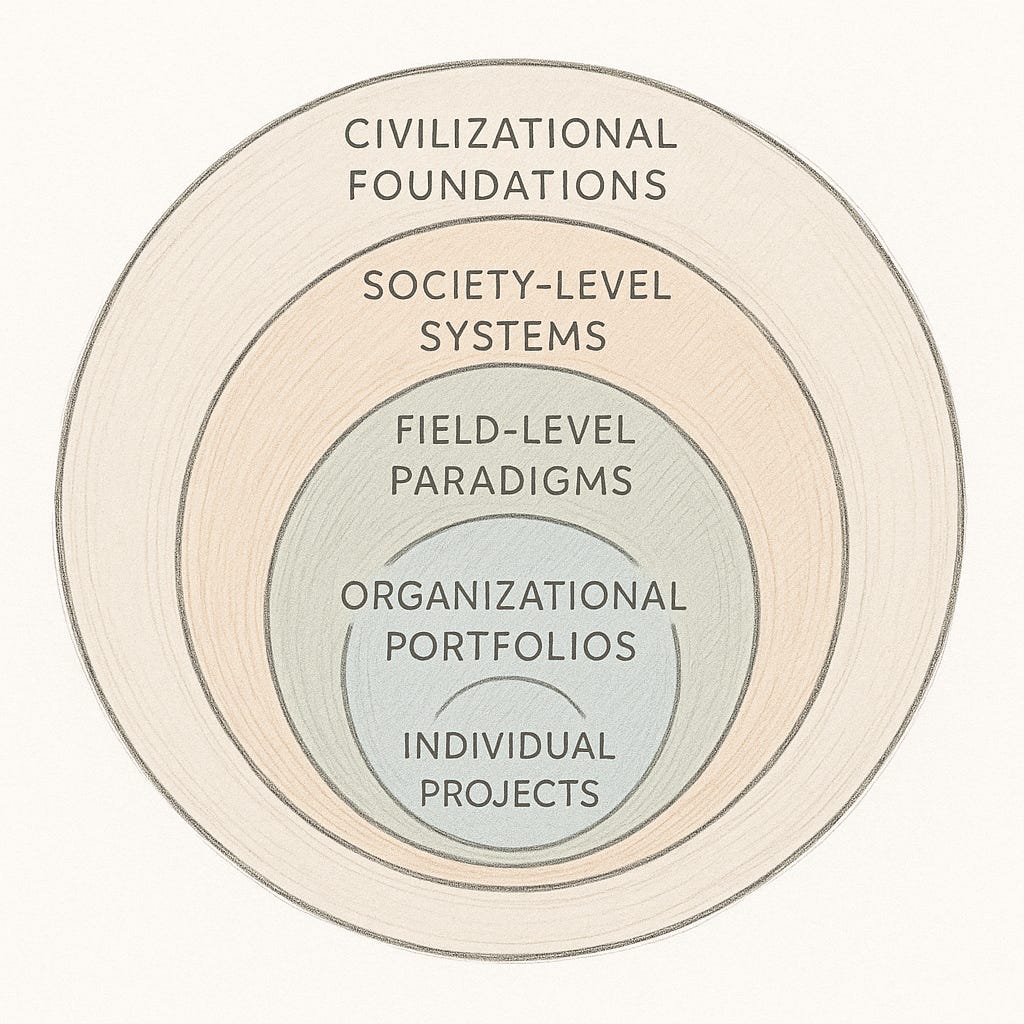
For clarity, we use the following operational definitions of each layer:
Discrete technoscientific endeavors: Individual projects—experiments, papers, prototypes, combinations, venture-backed startups, etc.—that push a specific claim or capability.
Organizational innovation portfolios: The way institutions (labs, companies, investment funds) select, resource, and govern a set of endeavors to pursue their goals.
Field-level paradigms: The fundamental theories and shared beliefs within a discipline—along with their associated norms, tools, and agendas—that define how the world works, what questions are worth asking, and what counts as valid answers.23
Society-level systems: Public sentiment, markets, culture, media, and policy that create the broader environment in which fields and organizations operate.
Civilizational-level foundations: Long-run trajectories and constraints—values, demography, resource base, infrastructure, geopolitics—that set the conditions for society and innovation.
And while Mr. Brand distinguishes his layers by their pace (ranging from immediate to long-term), innovation layers are most easily distinguished by their degree of agentic action. At the microscopic level, agents undertake actions to pursue their goals. At more macroscopic levels, individual decision makers increasingly give way to systems that ‘decide’ through structural forces that shape and constrain individual choices.
Innovation Layer dynamics
The boundaries between these layers are fuzzy rather than sharp. For instance, a university research lab sits at the intersection of Layers 1 and 2—it’s both a site of discrete experiments and an organization managing a portfolio. This fuzziness explains why conversations about innovation are so challenging: when I discuss structural factors with an individual innovator, we’re often talking past each other because we’re anchored in different layers without realizing it.
Interfaces between simple systems are often just a form of communication. A thermostat tells the furnace when to turn on; the furnace responds. Clear signals, predictable responses.
But innovation isn’t a simple system. In complex systems, interfaces are sites of influence and counterinfluence. Signals travel across layers, elicit responses, and return as feedback—but are changed by their journey. The result is not simple communication but an ongoing negotiation among layers, where signals are actively constructed through the interplay of different perspectives, incentives, and constraints. For example, researchers interpret funding directives through the lens of their expertise, incentives, and career risk; policymakers filter scientific findings through political feasibility and public opinion.
To make that more tangible, consider the following:
A 2023 Pew Research survey found that the share of Americans who believe science has had a mostly positive effect on society has fallen by sixteen percentage points since before the pandemic.
A common diagnosis is that scientists have lost touch with the public and fail to convey their work’s importance. While better science communication might help, the layers framework reveals a deeper friction: how signals propagate and reverberate across layers—or fail to do so
Consider one model for how societal priorities ought to flow: What society values (Layer 4) should influence which questions disciplines prioritize within their paradigms (Layer 3), which should guide institutional funding (Layer 2), which should enable what scientists pursue (Layer 1). In practice, these signals bounce between layers rather than flowing cleanly, but the overall direction matters. Yet somewhere in this process, the signal degrades. We fund space exploration while clean water technologies languish—not because society doesn’t value clean water, but because the layers have become decoupled.
As another example, a recent conversation of mine went something like this:
Me: I’m concerned that structural factors are preventing scientists from pursuing their best, most transformative work. Often, this manifests as scientists “choosing”4 safer, more incremental work over ambiguous, potentially-more-transformative work.
Scientist Friend: I think that all scientists believe they are doing something that is truly pathbreaking and transformative; the headwinds against science are just too great for anyone to persist in if they don’t believe that.
When interpreted through the Innovation Layers framework, what once was a disagreement now becomes a cross-layer disconnect. We were each speaking truthfully about different layers of the same system. In the conversation, I wasn’t questioning scientists’ ambitions—individual researchers absolutely strive for transformative discoveries. My concern lies with the layers above them. These higher-order systems channel scientific exploration—in a subtle but powerful way—toward narrower, safer paths, creating a gap between what scientists want to pursue and what the system enables them to pursue.
Implications of the Innovation Layers framework
The Innovation Layers framework reveals how signals reverberate between layers and how systemic forces shape those signals. It shows why those making decisions about innovation so often feel like ships passing in the night. When Congress asks ‘Why can’t we cure cancer with all this funding?’ while oncologists explain that cancer is hundreds of different diseases, they’re operating from fundamentally different layers.
These cross-layer misunderstandings shape how we allocate resources and set policies. They drive investment decisions that miss transformative opportunities, research policies that constrain rather than enable, and institutional reforms that target symptoms rather than causes.
This framework highlights three key insights that can revitalize how we approach innovation challenges:
First, it provides diagnostic illumination. Rather than vaguely gesturing at systemic problems, we can pinpoint where breakdowns occur. Take the persistent gap between scientific discovery and translation/commercialization. Scientists make valuable discoveries, but organizations (universities, companies) often lack the mechanisms—and the incentives, capabilities, and expertise—to recognize, develop, and steward them.5 Thus, scientific ‘fruit’ rots because the institutional pathway from lab to market is murky.
Second, it reveals why well-intentioned reforms often fail. When we try to fix the replication crisis by punishing individual researchers (Layer 1) or creating stricter journals (Layer 2), we miss how the problem emerges from misaligned incentives across multiple layers—from institutional promotion criteria to field-level publishing norms to systemic funding pressures. Solutions targeting just one or two layers can’t address a multi-layer dysfunction. The innovation ecosystem is littered with such misfires—accelerators that can’t bridge the valley of death, corporate innovation labs that can’t escape quarterly earnings pressure, publishing metrics that can’t redirect entrenched incentives. The framework predicts these failures: interventions targeting the wrong layer are doomed from the start.
Third, it reveals leverage points for change. Different types of interventions work best at different layers. Trying to fix a Layer 4 problem (like public distrust of science) with Layer 1 solutions (like better individual science communication) is like trying to steer a ship by blowing on the sails. The framework suggests that rather than trying to force paradigms to align with societal values, we need better interfaces that translate between what science tells us is possible (Layer 3) and what society needs (Layer 4)—mechanisms that channel capabilities to priorities without compromising scientific integrity.
Consider how this framework illuminates the current AI boom. At Layer 1, researchers are achieving remarkable breakthroughs. At Layer 2, organizations are pouring unprecedented resources into AI development. But at Layer 4, society is increasingly anxious about AI’s implications. The layers are dramatically out of sync, creating friction that manifests as regulatory battles, ethical debates and public backlash. The framework suggests that sustainable progress requires better interfaces between layers—mechanisms that allow societal concerns to shape organizational priorities and field-level paradigms.
When layers do align, transformative innovation becomes both possible and invigorated. The development of mRNA vaccines during COVID-19 exemplifies this alignment. Societal urgency (Layer 4) reshaped regulatory systems, which enabled new organizational approaches (Layer 2) to support long-marginalized scientific work (Layer 1) that had been trying to establish itself among existing field paradigms (Layer 3). The result accelerated a process typically measured in decades into one measured in months.
The Innovation Layers framework is a tool for cultivating better innovation systems. By understanding which layer we’re operating in and how it interfaces with others, we can craft interventions that work with the system’s emergent dynamics rather than against them.
Why Innovation Layers matter
Most frameworks for understanding innovation focus on what happens within a single layer—how to run better experiments, build better portfolios, or design better regulatory policies. This framework does something different: it reveals the hidden architecture of how innovation is influenced by the interplay between distinct but connected layers.
This matters because it transforms how we diagnose problems. The framework hints at why transformative breakthroughs seem increasingly rare despite enormous investment: we’re optimizing individual layers while neglecting the interfaces between them.
More practically, it provides a common language for productive disagreement. When stakeholders can identify which layer they’re discussing—or whether they’re actually negotiating an interface between layers—conflicts transform from ideological battles into practical negotiations. A scientist advocating for basic research and a policymaker pushing for commercialization aren’t enemies—they’re stewards of different layers that must work in harmony.
A substantial and growing body of evidence points to our innovation system operating below its potential. And in an era where our civilizational challenges—climate change, pandemics, inequality—require both radical innovation and effective deployment, we can no longer afford innovation layers that operate like parallel universes. We need them to function like a symphony, where each section plays its part while listening and responding to the whole. The operative question is then whether we’ll continue to tinker with individual layers while ignoring the spaces between them, or whether we’ll build the connective tissue that allows transformative ideas to flow naturally from discovery to impact.
The Innovation Layers framework invites us to see innovation as a system of relationships, not silos. By deliberately designing the interfaces and incentives between layers—and the institutions that straddle and negotiate them—we can turn misalignment into momentum, ensuring that the ideas with the greatest potential don’t stall in translation but reach the people and places that need them most.
In my writing, I almost always use “technology” in its broadest sense, as I am here. An iPhone is a technology, but so is a drug or vaccine, a type of business organization like a C-Corp or LLC, a financial investment tool like equity or debt, a system of government like a monarchy or democracy, etc.
This usage follows Thomas Kuhn’s conception of paradigms in “The Structure of Scientific Revolutions.” In his conception, paradigms represent not just shared practices but the prevailing fundamental frameworks of understanding reality itself.
This layer lies partially inside and partially outside of the human-centric framework laid out here—i.e., society has no ‘vote’ in how the universe works, and paradigms are the current frameworks for explaining those workings. Even so, I think it is pragmatically useful to situate paradigms here, since they do interface with (at least) (a) what kinds of innovations are pursued and (b) how society hopes to benefit from focusing on some (and not other) paradigms. For more on the interface between paradigms and technology, I suggest starting with W. Brian Arthur’s “The Nature of Technology: What it Is and How it Evolves.”
I use scare quotes because the word “choosing” implies a high level of freedom to decide among all of the available options. In reality, this level of freedom does not prevail in our current system of scientific funding.
I wrote about specific versions of this in Leaving Innovation on the Table (Part 1) and Leaving Innovation on the Table (Part 2).